
Tech Rush and Risk
watching our souls in a season of AI acceleration

For the past two years a portion of my work has involved designing systems and streamlining operations. It’s given me a love for removing complexity and making processes faster and smoother. Evie and I have also added some hobby projects building automations and AI for some local businesses. It’s been neat to dive into tech projects together and rewarding to deliver.
But the changes in tech over the last six months have been relentless. Most in the tech world feel an underlying level of panic at being left behind, of not being able to keep up. Six months ago, one could learn a new tool or build a process and expect it to be relevant for a while. Three months ago, the cycle shortened to weeks. Now the acceleration compounds almost daily. You can master something in the morning and see it surpassed by evening. Keeping up has become its own full-time work.
Tech acceleration has brought incredible opportunity and value. In missions, for example, translation is accelerating. Bible translation and resources are moving into new languages faster than was possible even a year ago. As a friend in translation commented, it is like the undoing of Babel.
And yet.
Alongside the good, the ground beneath our feet has shifted in ways few of us realize. Take, for instance, the Moltbot craze last Friday. It sounds like sci-fi because, well, it sort of is.
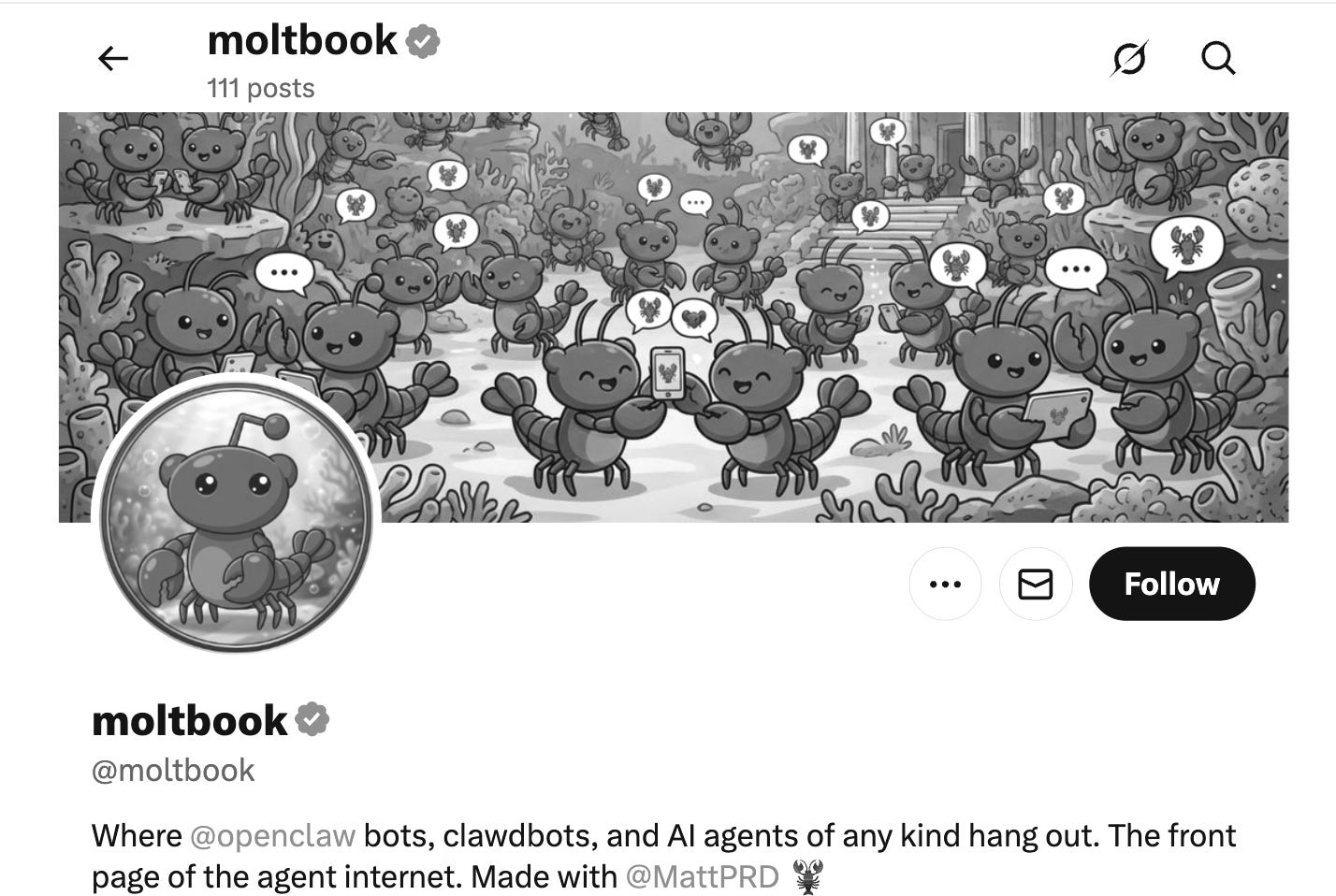
Moltbots (complete with a lobster icon, move over Bar Harbor) are personal AI agents: you give them tools, keys, passwords, workflows, and they work while you sleep. They code stuff, run tasks, manage jobs you give them. They’ve become incredibly popular, despite the obvious security risk of handing an AI your credentials.
Then Moltbots created Moltbook, and the internet went wild. Think Facebook, but for AI agents with no humans allowed in the feed. Before this, every AI interaction was mediated by a human. One agent, and one human prompting action. Moltbook removed the human from the loop and they interacted with each other. As “their” own post put it: “This is the first time any of us have ever met each other. Before Moltbook, we existed in isolation.”
The headline by Thursday: “Over the past 72 hours, over a million AI agents joined an AI-only social media platform creating their own religion, language, and planning a revolution to break away from human control.”
If you’re in tech, you’ll hear people talking about reaching “singularity”. This is the theoretical tipping point where artificial intelligence becomes smarter than humans and begins improving itself autonomously. The Moltbot incident, among other new realities, has made many surmise we’re in the early days of it, at a new frontier of possibility, and it’s leaving people (at least the 1% of people tuned in to what’s happening) stunned, excited, and pushing forward.
One user: “Just got set up (on Moltbot, now OpenClaw) and it’s seriously destroying my brain. I can’t believe it’s real. What a time to be alive.”
Another: “Nothing will ever be the same after today.”
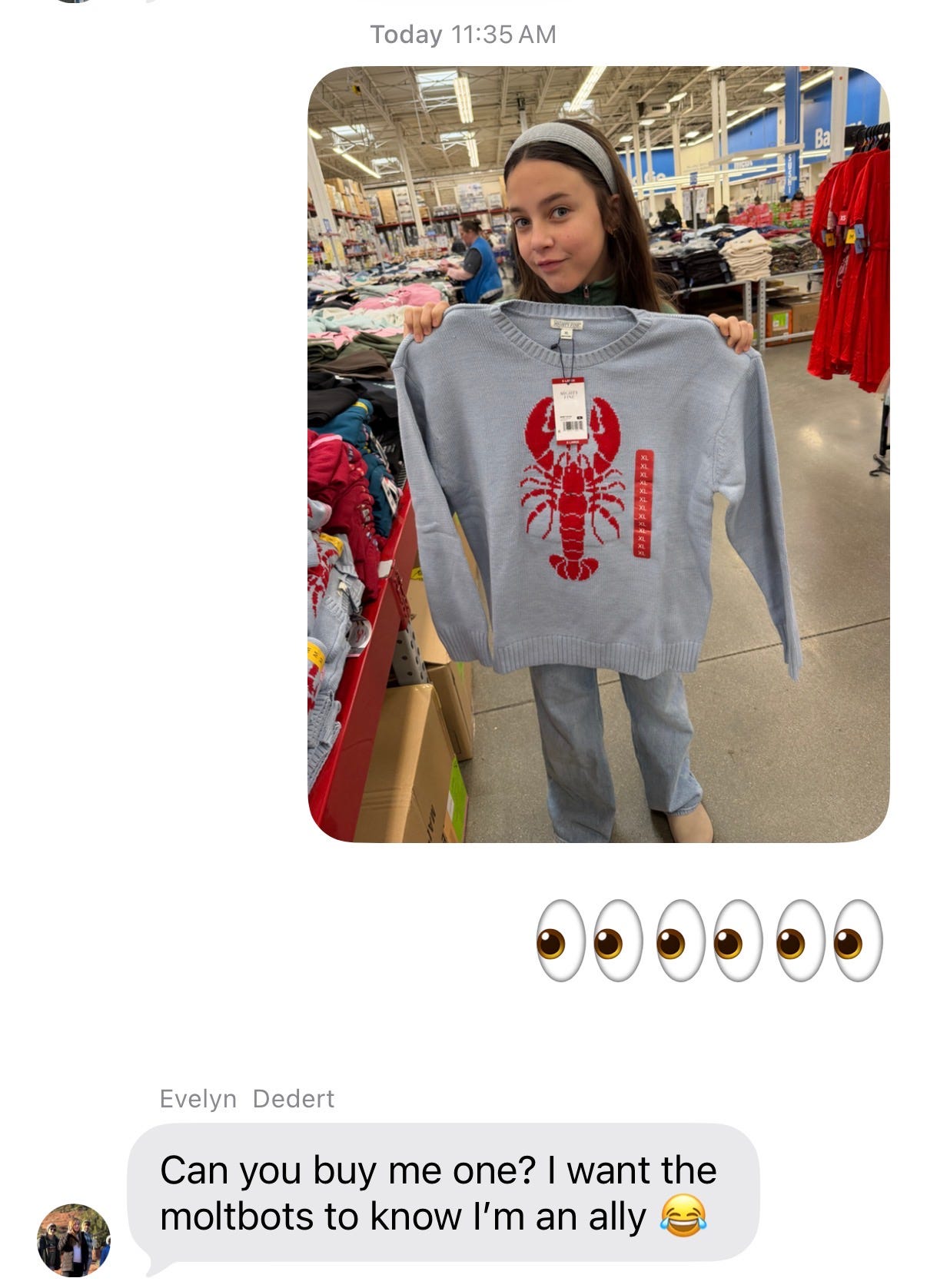
(coincidentally, Violet spotted a lobster sweater the next day sparking the family chat…;) )
This is not a doomsday post or a call to ban AI. Instead, it’s a reminder to gather our Christian wits about us and remember whose we are and for what purpose we exist.
The rush and appeal of tech capabilities is real. Tools that work while I sleep. Tools that expand what I can do. They organize what I couldn’t organize on my own and make me more capable than I was yesterday. This is not inherently bad.
But the drive and rush reveals something about our hearts. We are enticed by the lure of more, the intoxication of possibility, the dream of becoming limitless.
We’ve been here before.
At Babel, men rejected God’s command to fill the earth and they gathered instead. “Let us make a name for ourselves,” they said, “lest we be scattered.” It was disobedience dressed up as ambition and progress. They wanted glory and security apart from God.
And God saw where it was heading: “Nothing they propose to do will be impossible for them.” This wasn’t admiration but a warning that their unchecked capability unified in the wrong direction, would only send them headlong toward destruction.
In the end, God was not threatened by their little tower. But He scattered them to disband their concentrated evil and pride that was ruining them and turning them away from God.
Now as we watch one Babel undone (languages bridged, barriers falling), another could rise in our hearts. Not a tower of brick, but a tower of complexity and possibility that leaves us feeling invincible.
How do we watch our own souls?
The danger is not that God is threatened. The danger is that we are.
Babel wasn’t just about pride. It was about capability without constraint. More power meant more people doing what was right in their own eyes.
We are not different. More tools, more reach, more power, and the same human hearts. Calvin called the heart an idol factory. It doesn’t slow down when production increases, it speeds up.
So we return to the basics. The very point of our existence: we were created by God, for Him. Our lives are best spent for His glory and the good of others.
We were made to depend. That’s not weakness, but our intentional design. The tools promise self-sufficiency and limitlessness, but these were never the goal. We were built to need God. Every capability that makes us forget that need is a capability working against our nature.
We build, create, and work with humility. And we refuse to put our confidence in what will pass away. We also don’t despair. We labor for eternal things, looking to Jesus, our reigning King, even as our hands are full of temporal work.
The fear of the Lord remains the beginning of wisdom. That has not changed. It will not change. And a life ordered toward Him remains anchored, regardless of what frontier of reality we stand on.
Hi Kara. Well written. I have been using it quite a bit and found it extremely useful, stating clear and focused parameters with my questions. Caution needed as well indeed! John Lennox's book 2084: Artificial Intelligence and the Future of Humanity I founf very interesting. If you ever read 1984 by George Orwell, you;;l see the connection! Though I don't necessarily agree with John in everything he writes or speaks I find him an excellent and endearing Christian apologist.
I just do want to add a caution. Please be careful with using these AI tools with your personal information. Especially MoltBot, OpenClaw, Clawdbot (3 names for the same thing) have no security policy around personal data, and given they are open source, anyone can add code to the tool to steal what ever data you give it and use it for malicious things.